Hindro Setyawan, S.Pt
Technical Support – Research and Development PT Mensana
Coccidiosis is one of the classic poultry diseases that has existed for decades, yet it continues to pose serious challenges in the field today. This disease is commonly referred to as bloody diarrhea disease due to its characteristic clinical symptom. It usually affects young chickens, primarily because their immune systems have not yet fully developed. The condition is further exacerbated by housing systems that still rely heavily on floor-based pens or suboptimal litter management, such as damp and compacted litter conditions. In addition, the ban on the use of antibiotic growth promoters (AGPs) in feed has also contributed to the increasing incidence of coccidiosis outbreaks in poultry farms.
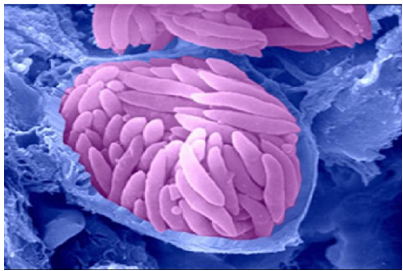
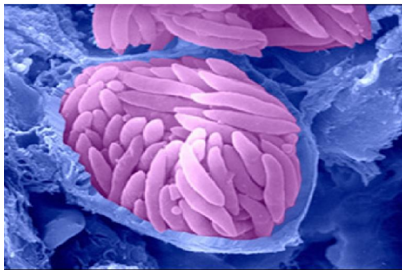
Eimeria sp. pada mikroskop electron (www.bbsrc.ac.uk)
Coccidiosis causes significant losses in poultry productivity. Chickens infected with coccidiosis commonly exhibit symptoms such as reduced appetite, weakness, and dull feathers. The most distinctive sign of infection is a change in fecal appearance. Initially, the droppings may turn brown and eventually progress to bloody feces, indicating intestinal hemorrhage. Such intestinal damage negatively affects feed intake and nutrient digestibility. Moreover, the intestines play a crucial role in immune defense, making affected chickens more susceptible to secondary infections due to immunosuppression. One of the diseases most commonly associated with coccidiosis complications is necrotic enteritis.
Understanding the Life Cycle of Eimeria sp.
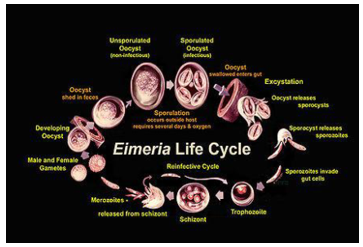
Life cycle of Eimeria sp. (www.websters-online-dictionary.org)
A proper understanding of the life cycle of Eimeria spp. is essential for implementing effective prevention and treatment strategies against coccidiosis. Eimeria spp. develop through two main phases: the asexual phase and the sexual phase. The asexual phase begins with the development of the oocyst into schizonts and merozoites. Oocysts, often referred to as the “eggs” of Eimeria spp., possess thick walls that make them relatively resistant to environmental conditions. Oocysts contaminating litter, feed, and drinking water become the primary source of infection for chickens. The sporulation process, or maturation of the oocyst into its infective form, takes approximately 48 hours under optimal conditions.
Each oocyst contains four sporocysts, and each sporocyst contains two sporozoites. Once ingested, the oocyst wall is broken down in the gizzard through mechanical action, as well as the influence of chymotrypsin and bile salts. Upon reaching the small intestine, the sporozoites penetrate the epithelial cells of the intestinal mucosa, where they multiply asexually and develop into first-generation schizonts and merozoites.
These first-generation merozoites are then released from the epithelial cells and invade new epithelial cells, where they develop into second-generation schizonts and merozoites. The second-generation merozoites are released and re-enter epithelial cells to develop into microgametes and macrogametes. The fusion of microgametes and macrogametes marks the beginning of the sexual phase, resulting in the formation of a zygote, which later develops into an oocyst. This oocyst exits the intestinal epithelium and is shed through feces, contaminating the surrounding environment. The complete life cycle of Eimeria spp. generally takes approximately 4–6 days.
Controlling Eimeria sp.
Based on the life cycle of Eimeria spp., regular monitoring of chicken feces is crucial for early detection of coccidiosis, particularly when discoloration is observed. Laboratory examination to detect the presence of oocysts in feces is highly recommended, especially in farms with a history of coccidiosis outbreaks. Chickens showing brown or bloody feces should be isolated immediately.
Litter quality must be maintained to suppress oocyst development, especially considering that oocysts can sporulate and become infective within two days under optimal temperatures of 25–33°C. The application of limestone is a traditional yet effective practice for inhibiting oocyst development, particularly because oocysts are highly resistant to many disinfectants.
The use of slatted or battery cage systems is strongly recommended for farms with a high risk of coccidiosis. If non-slatted floor housing is used, concrete flooring is preferable as it facilitates cleaning and disinfection. In addition, providing dedicated footwear for each poultry house can help prevent the spread of oocysts through contaminated footwear.
Maintaining optimal intestinal health is a critical strategy for controlling Eimeria spp. Considering that the parasite requires 4–6 days to complete its life cycle within the intestine, a healthy intestinal environment can suppress its development. Furthermore, a healthy gut supports the stimulation of the chicken’s immune system, particularly local intestinal immunity, enabling the development of protective immunity. A precisely formulated diet plays an essential role in maintaining intestinal health by minimizing undigested feed residues excreted through feces. Balanced feed formulations that meet the nutritional requirements of chickens can reduce cases of dysbacteriosis and bacterial enteritis, thereby indirectly lowering the risk of coccidiosis. The use of feed premixes such as Masamix, which support optimal digestion and nutrient absorption, can further contribute to intestinal health.
Appropriate medication can also help treat and control coccidiosis outbreaks. Coxymas and Quinoxan are examples of medications commonly used for coccidiosis treatment. These medications should be administered at the correct dosage and duration to ensure optimal effectiveness. Supplementation with vitamins containing high levels of Vitamin A is also beneficial for maintaining and restoring the intestinal mucosal epithelium.
Effective coccidiosis control requires a comprehensive approach that takes into account the life cycle of Eimeria spp., integrating proper farm management practices with appropriate medical treatment.
